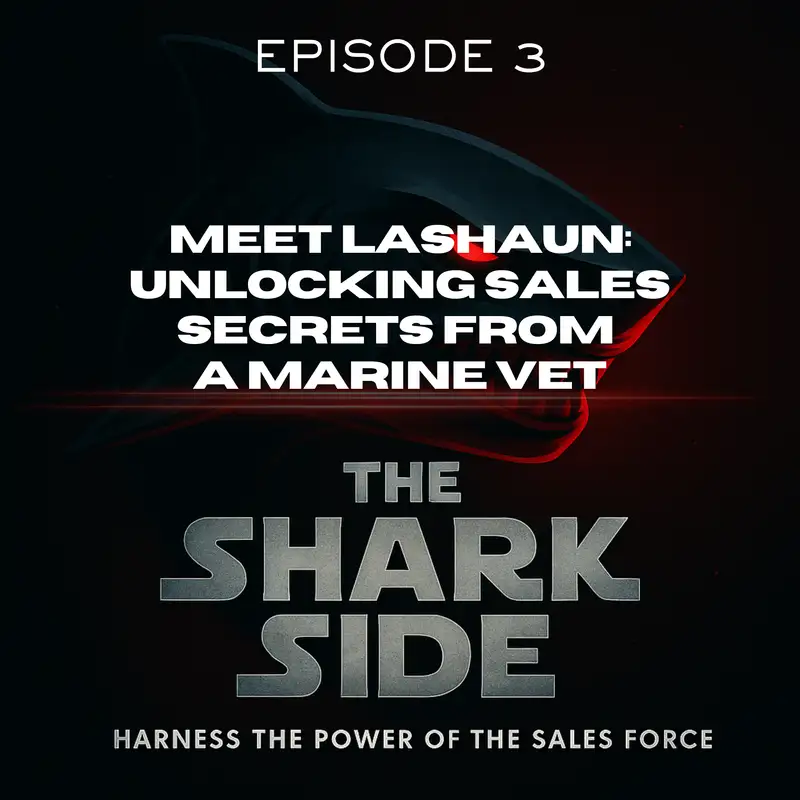
Episode 3: Meet LaShaun: Unlocking Sales Secrets from a Marine Vet
Download MP3In every deal, there's power, persuasion, and performance. This is the Shark Side, where ambition meets discipline. Welcome to the Shark Side. Hey, everyone, welcome back. This is the Shark Side, where quiet discipline meets real results. I have a phenomenal guest for you guys today. Sean is in here, old-school sales guy.
Love to have old-school sales guys on, talk some real stuff. Dove dog marine. So we'll maybe talk a little bit about that.
Who knows? I'm Army, so who knows what direction that will even go. But we'll have a little bit of fun, like usual, talk a little sales, a little business, and whatever else comes up. So welcome, Sean. You want to introduce yourself a little bit?
Yeah, yeah, yeah. So nice to meet everybody who's looking, who's not met at all. But my name is Sean. Yeah, I've been doing sales since I retired.
I retired May 2024, 20 years in the Marine Corps. So I'm an old man, you know. Sometimes I like to dye my beard sometimes, so I don't look so old. But yeah, so I've been retired now for a year and a half. Okay. And you started in sales a year and a half ago? Yeah, so I started when I retired May 3rd of 2024.
I started doing sales June, June 6th. And what'd you sell? But you started right into windows. Started right into windows, man. And what made, what'd you do in the Marines? So my primary job was actually working on fighter jets.
Okay. Yeah, so I spent like the last 12 years working on F-35s. The first eight, I was on Harriers. I'm an avionics guy, so I'm a bit of a nerd. So I'm smarter than I look, I guess. But nose to tail, man. Radar weapons, navigations, countermeasures, software, crypto, all that good stuff.
And so you got out of the Marines, and out of all of the things you could do, you were like, I think I'll just get rejected all day long. Yeah. So how did you, walk me through making that decision. Did you consider other things? What made you decide sales was something you wanted to do? Yes, good question, man. So honestly, myself, so I joined the Marine Corps.
I graduated high school June 5th. I went to the brew camp on June 6th. Literally the very next day, I turned 18 a month and a half before I left. So I was fairly young, man. So I spent the entire adult years of my life in the Marine Corps. And so for myself, I kind of broke my life up in the chapters, is what I like to call it, right? So chapter one was before the Marine Corps, and chapter two was everything the Marine Corps had to offer for me.
And this was chapter three, you know? So for myself, I just didn't want to do the same thing in every chapter of my life. And people kept telling me, you know, when I was in the Marine Corps, like, hey man, you ever thought about doing recruiting? You know, cause like, I like to talk, you know, just kind of how I am. I'm like, like, nah, people tell me that, but I don't want to do recruit, man. You know, I don't want to work those hours and just have to force somebody into something they don't want to be into. But so people just kind of kept telling me like, you know, maybe do good in sales. And so of course, me working on fighter jets, the primary job everybody wants to do when they first get out is, hey, we're going to work for Lockheed Martin or Boeing, or do I, I'm not even gonna lie to you guys.
I turned down a job from Gulfstreams, cause they, you know, and they just had two different resumes, but I had one that was like all aviation stuff. It's kind of like a fallback, you know, in case things don't work out in sales, I got something I can always go back to. So I had, I put in for Gulfstreams, had Connex and everything over there, $45 an hour, $15,000 sign up bonus. And it just didn't feel right. I was just like, no, like, I don't, I don't want to keep doing the same thing. You know, I wanted to take a chance on myself and just kind of like really just grow in an area that I haven't really seen for me. So I got a phone call literally like around the same time to do sales for Windows.
That was an entry-level position. Got in just as a door knocker, you know, getting out there knocking doors. And I was 38 years old, fresh retired from the Marine Corps. And here I am out there in the streets, beating down doors, you know, kind of very similar to what I did at the beginning of the Marine Corps. But that's kind of how I got into it, man. I got my foot in the door there. Did you, did you get good training?
Was it, was it baptism by fire? It was a little bit of both. It was a little bit of both. I had great training, which is pretty much like about three or four days. And it was like, boom, right in the fire, you know? But I think it was something that I'm, I try to be the best, genuine, nicest person I am with anybody, right? And that's just who I am.
And I don't think I have to try too hard. I think it's just, that's just natural who I am. You know, my parents raised me to be like that. I can also be a monster when I need to be as well, but I try to present myself to every single person as just a nice person, you know, because that's who I want to be. So for myself, getting into sales and knocking doors, it was hard, but I loved it. Like, I loved it. I loved the excitement of just like not knowing who's going to answer the door.
It could be some crazy experience. Some old 70-year-old man is butt naked. You know, he's like, hey, what do you want? You know, I get yelled at and I get, you know, I get screamed at or people answer the door with a gun or with a dog, you know? But that's what I like. And I know it sounds kind of crazy, but it was just that excitement of the unknown. Sure.
You know, it was just, I was kind of addicted to it in the beginning. Yeah, so, so we met working in the same building, different offices, same building. And I would see LaShawn talking to other salespeople, hear some role play here and there. And, and I would tell you, like, I thought you were way more experienced than, than you are. So I'm surprised to hear that you, that you've only been doing it for that short of time. You know, one of the, one of the principles I have, because especially when you get in the door-to-door world, you get a lot of manipulation, a lot of tactics. There's a lot of, you know, and I don't know how much you looked outside of the training you got, but if you do anything on YouTube or, you know, some podcasts, you're going to hear a lot of guys.
And the more you zero in, there's a lot of manipulative tactics in there. They're talking about when they say this and you say that. And I had a rant on my first, very, very first podcast about the people that would, you know, you'd, you'd get to the door and the wife would be there and maybe she'd be a little interested and say, well, I need to talk to my husband. And, and like companies have actually trained like, well, let's get him on the phone. And I was like, hmm, like, I'm not, I'm not that guy. So, you know, I, I do come from a very similar approach to you, which is like, we have to have a certain level of relationship and most relationships are built on trust and respect. And, you know, all I'm asking for when I'm at the door or when I'm in a meeting is, you know, I would like to be given the opportunity to show you why I should be trusted and respected.
We can talk about money and products and stuff after, but, you know, the first step is being respectful and understanding that, you know, especially in the door-to-door world, nobody's, nobody's asking us to be there. It's different when you're in a situation where somebody responds to an ad or a piece of direct mail, you know, and they call up and they say, well, I'd really like somebody to come in and give me a bid on a roof or on siding or on windows. And you're going there knowing, as opposed to knocking on the door and you hear crazy stuff when you're on the doors.
Oh, yeah, like just crazy stuff. Just, and then you have people who like, literally they could, you could notice their windows like falling off and cracked and they won't let you get one sentence out. But then you have other people that don't want to buy anything, but they will like want to tell you like about their, you know, daughters getting a divorce and their grandkids. And it's like, all right, well, it was a good meeting.
Yeah. And you're like, all you're seeing is like, oh man, I'm like, I'm like 10 doors behind where I should be right now, so. So how do you, how do you deal with, because the hardest thing we do in sales really is positioning our minds to say that the 39 people that said no wasn't a failure. And in all these, cause I've been doing this for 40 plus years and I've worked with, you know, in the thousands of training of salespeople. And the biggest hurdle to get in is to get them off of like feeling defeated because in my career, I mean, God, there's probably been hundreds of thousands of people that have told me like, get out of here. Yeah, yeah. But I've never, I mean, luckily for me, I was just built such that like, it didn't really bother me.
I was just like, okay, well maybe the next one will buy something. And then they said no. And I was like, okay, well, I mean, I know sooner or later somebody's gonna buy something.
So technically I'm getting closer. There you go. So how did you deal with like that constant getting hit in the face with no on the doors? Yeah, I think that last phrase you did right there is just exactly what it is, right? It's just every no is one no closer to a yes. And it's just, once you have that perspective shift and this is with anything with life, right? It's all about perspective, right?
We can't get away from rejection in life. We can't get away from people telling us no. We can't get away from the bad and unavoidable things, right? But we can always have a perspective on it. So I can never say I knock on the door and if every single person told me yes, that'd be phenomenal. But I'm expecting the no. But the no's, I gotta get those out of the way to get to my yeses, you know?
So I had a homeowner actually tell me this phrase. He said, man, you kiss enough frogs, you'll find a prince. And I thought that was phenomenal because that's what it is. Like I knock on enough doors, I'm gonna find a yes. But I knew like for myself, like I was just tenacious, man. I didn't wanna come home and tell my family like, hey, dad didn't get a set today. I didn't set no appointments today.
I didn't get any yeses, you know? So I stayed out there and I kept pushing. And there were days I was knocking, you know, my average was $200 a day, you know? That's a lot. I had a crazy day where I knocked 400 doors. It was last summer, 117 degrees outside. I knocked 400 doors in that one day.
People looking at me like, man, what is wrong with you? Like, are you crazy? I'm like, no, I'm a retired Marine.
That's what we do. So what transferred from being a Marine to being in sales? That's tenacity, man. You know, that ability to face adversity and keep pushing forward. And that's for me like was everything, especially in door-to-door. You know, like it's very easy to get consumed and to know when, and you know, people wanna protect your mental health and all these things while there's negativity. But for me, it's like, man, I'm spreading positivity out here.
Even the people who tell me no, it's like I'm still giving them something good. So, so just myself, just my ability to look at an adverse situation and say, I'm gonna make it out no matter what. You know, and I tell all my guys, say, if you don't think you can get through what you're going through, look at what you already been through. And so I've been through a ton, you know, in my life and my career and all those other things. And it's like, to me, I feel like it's nothing can stop me. You can tell me no all day long. And I'm gonna smile and say, God bless you.
I'm gonna keep pushing forward. You know? See for me, cause it, being in the Army wasn't that hard. I mean, I'll be honest with you. It was just, it was like, it was no more taxing than being in a sport to me. It was kind of similar, but I really attached myself to processes and it really got me thinking in terms of process for everything. So I always went into sales trying to break it down to, because I thought to myself, like every time we had a process, we would look at the process and we would say, okay, now we have process.
What could go wrong with the process when the process goes wrong? How do I respond to that? And I looked at it and I'm like, well, why wouldn't I, you know, want that for my business? Why wouldn't I organize my day the way I did, you know, with the discipline and the strictness? And then why wouldn't I discipline myself and have a process for how I talk to people? Like, because there's gonna be days where, you know, life comes along and I am distracted. And I thought to myself, well, if I'm distracted, I always have the process to go back to.
You know, I always, I won't forget to ask questions. And that's the other thing, you know, in order to really do the best job I could do helping people, I had to ask a lot of questions to understand where they were and, you know, I think when I look back a lot at when I was first in sales or when I'm training people, a lot of it is they're so busy to, excuse me, they're so eager to get to, let me tell you what I can do that they forget to ask a lot of questions. And so for me, that process was just critical. Okay, so now you're doing the window thing, knocking doors, and then you built a team. What's harder, selling or building a team to sell? So I'm gonna be honest with you. So the team was kind of built for me already.
I started in, like I said, at just entry-level position called just the marketing coordinator, right? So I kick butted that, man, you know, I did my thing out there and I was only a coordinator for three months. So at about the three-month mark, they approached me and was like, hey, you wanna become a junior sales director? So at that point as a junior sales director, my job was to go out and I set my own appointments and I run my own appointment. So I'm doing them both, right? So I did that and it's only like a month and a half and I was pretty successful with that as well. And they was like, hey man, you're a senior director now.
So now I'm able to go and run other people's appointments. So I think it was probably like six months in, I was a senior director. So I started from entry-level all the way up and then just keep doing my thing with that. I was a primary guy and then the team was just kind of there. I had my senior guy who moved up and he moved out. And then I came up into the next position as an FCO, which is basically like now I'm in charge of all the training and in charge of all the area management and people's personal problems and just everything going on. What's your biggest frustration trying to train people?
I would say my biggest frustration trying to train people is just being able to, especially cause, so this job's commission only, okay? My biggest frustration when trying to train people is getting people bought in on the idea and the possibility of life-changing money. And it's like, you know, anybody can come into any job and like, I can teach you just the basics, you know, like, hey, this is how you work the apps and this is how you knock on doors. You know, I can turn any person into a great door knocker, but it's when times get hard, it's the roughest part about training. And I tell people that from the beginning, cause I don't want people walking into something that they, you know, they're unexpected. And then before you know it, like, man, like I didn't get any sales this week or next week or the week after. So I'm very transparent to those guys, but I let them know cause I want to prepare them for worse.
And I think that's one of those things that, you know, we took from being in the military is like, you prepare your guys for the best and for the worst, but the more I prepare you for the worst, then the better you're going to be when it comes, you know? And then, so a couple of controversial things we'll talk about in sales in general, and number one, scripts. So did you have scripts? Do you like scripts?
Did you use scripts? Yeah, so we have a, we have a basic script for just our coordinators, right? And I would say that it. It is phenomenal, like to have people have just something that that's just a basis for them to go back to. Like this has all the information that the homeowner needs to know. It positions the director. So when the director comes in to run appointments, that there's just straight continuity.
So the homeowner heard this at the door and the director comes in and he's saying, it's speaking the same language. Um, as a director, I also had a script that was about eight, eight, eight pages long. Oh my goodness. Um, ton of information in there, right? It took me probably like a week and a half to learn this thing. Um, but I really liked it. Now, of course, I think Mike Tyson said, everybody's got a plan until you get punched in the face.
Right. Uh, we used to say that in Marine Corps, it's like everybody got a plan until the first round go down the range. And this is exactly how it is. Even just at the door, you have a basis as far as a script. These are all the information we get across, but I don't know what this homeowner is going to say. I don't know what questions they're going to ask. I don't know how they're going to react, but I have to be able to deviate from the script and do what I have to do as far as like building that trust and building that, that rapport at the door with these homeowners and then come back to the script, but the script is, it basically just was a foundation for me.
If I need this information, I always refer back to this. Same thing when I gained an appointment and I'm running appointments and closing deals, it's like, I got this whole long script, but based on the homeowner, I'm tailing it to them. You know, it's like, I'm coming in, I'm asking questions right away. Cause I want to know what are your pain points? What issues are you dealing with? What problem am I here to solve? And once I figured that out, then I'm just like, you shouldn't have let me in your house cause now you got to be out of my windows here in a minute.
You know, you don't even know what's about to happen to you, you know, but, but I love that, man. But my biggest part when it came to the sales was just my opportunity to help people, you know, I told people all the time, my guys, I said, money's a bad product, you know, we go into this with the right intentions and the right reasons and, and we're here to help. You know, we treat people like family cause we were a small family owned business and, and that's what it is. You know, so getting out there and we building that trust with people, but it's genuine trust. And I don't even like to consider myself a salesman. I go to people sometimes like, don't call me a salesman. I'm just a guy with the information.
If you like what I got, great. If you don't, that's great too. I met amazing people and I walk out with a smile. And that's, that's pretty much what I taught my guys, man. It's like, you go into, you knock on people's door with the intentions of helping people. I'm not here to take your money. I'm here to solve a problem for you.
And that's what we do. The money's just, it's going to happen as we, as we come along. Now, I, I, I'm a hundred percent bought into that. I believe truly that it's almost, I mean, we do sell, there's no doubt about that. But again, I, I think I'm exactly aligned with you that whatever I'm representing, whether it's advertising or windows or roofs or digital marketing, bottled water. Somebody needs it and somebody's going to buy it. And really I'm just sort of a conduit between some people who need it and some people who have it.
Uh, and, and I'm just trying to help both ends. And, and I think if you go out with good intentions, uh, because for me, uh, referrals and, and reviews have always been a big deal. And I think when you do the right thing, you start getting referrals and you, you understand that you, um, as a matter of fact, there's a chapter in my book that's called build, build an army, and it's just all about doing such a great job that you have a hundred or a thousand people out there. That when somebody needs something related to what you do, you have these thousand people out there just shouting your name, like, oh, you know, you need to talk to MJ because he did such a great job for us, or he did such a great job for my, my parents, or he did such a great job for my brother, um, because I think too many people go for that short-term kill without thinking like what that experience is going to be. Because, uh, one of my mentors taught me, you really, we, we had a big white board where we would write down our sales, like the number of sales and the total amount and everybody would be like, oh, I just closed, you know, two for $7,500 and they would be going to write it on the board and you'd go, hold up, did you get a referral? And they'd go, not yet, but, and he'd be like, uh-uh, you didn't close it yet. You didn't close, you didn't close that till you got a referral or, or a review.
And I think that when we sort of think in those terms and all of a sudden we do a little bit better job because we have to think about the longterm, like, you know, yeah, they might buy today and sign a contract and now a week from now, they're kind of like not happy with it. And then you, I don't know how much you got, um, involved with like the installation part of it or, you know, communication from that, but what tends to happen is when we talk people into things that they're not ready for, they don't really want, but they just, we overpower them, uh, because you, you know, you've got a strong personality, you in the right situation, you could probably tip the scales in a few instances that you didn't, by being a bit more direct by, you know, by telling them, I'll just sign today. And a little more assertive. Uh, but what ends up happening is those people get remorse. And then when the scheduling calls, they're not really happy with the schedule and then when the installation starts, you know, somebody stepped on a plant or somebody and all grace they would have had is gone because now they're just feeling negative about the whole thing, so they nitpick the whole process and then they leave a bad review and then if the neighbor across the street says, Oh, we were thinking about new windows, don't use that company because, you know, and they list off all these things. And so I think it, you know, I, it's, it's refreshing to hear somebody, especially in the newer generation, cause I'm the older generation, you're not the older generation. That really looks at sales like that, that, um, you know, you, you want that relationship because for, for instance, what would a good, not a great, but just a good, or you would feel good about yourself, number of sales you would make in a week?
Um, I would say five. Okay. You know, and a- A sale a day. Yeah, a sale, sale a day. So you're probably not going to work all 52 weeks cause you got to take some days off and maybe go on vacation, whatever. Sure. So that really realistically means you only need 250 people in all of the area to say, that sounds like a good idea.
I want to do this. And sometimes we lose perspective because, you know, everything's fast forward and everything's these big numbers now. And it's like, if we work that math backward, like all of a sudden all the pressure's off. And then we're just looking for the right 250 people. And I, I love a lot of the sales scripts and a lot of the approaches where the people do say, Hey, you know, I want to learn a little bit about you and I'll tell you a little bit about me and if it makes sense and we're a good fit, you know, then we can talk about installation schedule, pricing, all of that stuff. Because it takes the pressure off of both of you. Yes.
Cause you know, now it's just, all right, do we, does this make sense for both of us? And I jokingly talk a lot about sales being a lot like dating. Like none of us would knock on a door or see a girl across a room or a guy across a room and walk up and go, you're pretty good looking. You look like somebody I would marry. Would you, would you consider getting engaged to me today? Well, like in sales, we feel it's appropriate to talk to people like that instead of saying, Hey, like the, you look like a good candidate to do business with my company. I'd like to spend a little bit of time telling you, you know, what we do.
And if it makes sense, we can talk, we can talk about the specifics, the next steps. And I've had so much success, just, just gaining that initial conversation of, let's just see first, like, I'm not, I'm not going to give you pricing if you don't want it. I'm not going to, you at the end of the day, you hold the pen. I can't force you to sign anything. So why don't we have a quick conversation to see if this even makes sense? Um, and I think, you know, one of the things that I do like about door-to-door is by nature, it's very process oriented and it's very step oriented, uh, because in most cases, you know, when you have the canvas teams, their, their job is just to say, Hey, here's our value. Would you like an appointment to learn more?
And then the next person can come in and say, Hey, I'm like, I'm happy. And I'm honored that, you know, you're allowing us to have this conversation or, you know, whatever that conversation looks like, but, but it is very next step oriented, which I think is for me, I've always kind of trained that sales is a series of small sales. The goal is never the $20,000 window project, but the first goal is appointment. The second goal is that needs assessment, whatever that looks like, whether, you do a roof inspection and, but you have to learn about their situation. And then the third, the third sale is, Hey, I know your situation. Can I offer a solution, a solution? Can I offer some suggestions on, on directions you can go?
And then obviously you, uh, you know, you, you do that. And I generally welcome objections. Uh, I'm always scared when there's no objection and it's just like, Oh, that sounds so good.
Yeah. It's too good to be true right now. Yeah. Yeah. That's what I always say. Yeah. Um, so, you know, I do a lot of times I'll even throughout the process sort of say things like, Hey, this is, this is kind of concerns that many of my clients have when we're, when we're at this stage and, and then they feel okay saying, well, yeah, that is a lot of money or, you know, gosh, we don't have that kind of money.
Hey, no problem. We, one of our, one of our solutions for you is we have in-house financing or third-party financing or whatever that looks like. But, um, you know, objections for me are just more of a clarification. Um, you know, there's, there's, I would always talk about objections are either price or product.
Yeah. Like there's nothing else. Mm-hmm. They can use a million different words, but price or product. So the price really is, I don't have $20,000 in my bank account and I just filed bankruptcy.
Okay. That's a price objection that we can't overcome. I don't have $20,000. Okay. No, no problem. We have some financing options we can look at.
If they qualify, great. If they don't, so be it. Everything else is product. Meaning the product itself doesn't work or I like your product. I don't like your product $20,000. In which case, let's talk about that. What do you have that kind of, what are you comparing that to?
I'm just curious. Well, we had another company out here and they could do it for $17,000. I understand. You know, I, I do this. You do this, you know, you probably ran four or five appointments a day. I do this a hundred times a month and that comes up. And generally when that comes up, it's because of lower quality materials, longer lead times.
There's a reason it's associated to it. More workmanship, et cetera, et cetera. Um, you know, here's, here's your options as far as that goes. And so I just, but, but all of this is very, like you said, it's, it's intended to help them through the process. It's not intended for me to, to trick you into just being so uncomfortable that you, you don't know how to get me out of your house now. So you're just going to be like, well, I guess, you know, we'll, we'll try the financing.
Yeah. And I think, I think even just, just, you know, caveat on what you're talking about as far as objections. I like to tell my guys when I was training, you know, and I don't, again, I, my, most of my experience with this is just one just through life, but two, I've learned a lot of just watching videos and things like that. But also just having a neighbor ability just to kind of level with people. And for me, I've always looked at objections as my opportunity to show that I'm human. You know, I humanize myself. Like you, you expressed to me, like, this is a reason why you can't do something.
And I want to show you like, Hey, I'm human too. I get you. I'm very understanding that we all go through these different problems. We all got what it is. How can I help you solve this problem for you? Like, cause I'm still here and it's with or without my company. And I would tell them that, like, I would go through people's homes and I'd be like, Hey, um, you know, don't get, don't get these windows right here from me.
Go do it somewhere else because it's going to help you out more. And that's just for myself. And people give me an objection and say, Hey, I, I can't afford all these doing right now.
Okay. Well, what can you afford right now? Like, I want to be able to help you out. I don't care if it goes down to just one problem window. You know, I had a guy, this is a, this is a true story. I had a guy when it's home and he was telling me, um, he's like, man, I can't afford all my windows. Like, I know you want to do them all.
I was like, no, man, I want to, I want to help solve a problem for you. Early in that conversation, he told me he'd live in the house for five years. His kids, which their rooms just on the far side of the house. Uh, I think it's on the, on the West side of the house. So it's getting just a ton of sunlight. And he said, not once. And during the summer times, my kids been here, spend a summer in their rooms.
It's too hot. It's too hot. I told him, I said, dude, like, I don't even care about the rest of these. Let's get your kids taken care of. It shouldn't be uncomfortable in their own home. And I literally gave him the whole discount, gave him everything with it. But just those rooms for just his kids.
That guy called me after the install done. And he was like, Hey man, I want to let you know, I came out of a room looking for my kids. And they were in their rooms and it was emotional. We were talking. I was like, that's a great result. I was like, this is why I do my job. It's because like, you gave me an objection.
I solved a problem for you, man. Like I got you, you know? And that's a great example of we don't, sometimes we're, we're trying to hit grand slams when we can take a base hit. Two, fixing two or four windows is better than fixing no windows. And so, so that goes back to, I can't afford 20,000, 25, whatever it would cost 40,000. I don't even have a clue, but okay. Well, what could you afford?
If, if in a, in a perfect scenario, I could afford $4,000. I got a one credit card and I got $4,000 on.
Okay. Let me tell you what I can do for 4,000. I'm going to, I'm going to do the best I can do to solve as many problems that I can for $4,000. Here's what I can do. But I think again, you know, it just really all circles back to who are we in this for? And, and I think that, you know, one of, one of the core values of my company is. Relationships matter most.
And if I have a relationship, whether it's a one day relationship or a 10 year relationship, it's still a relationship. And I want to make sure that we're both winning. And if you have to win a little bit more than I do, I'm okay with that. Because I think, you know, in, in the grand scheme of things, stuff always comes around. So LaShawn, it was awesome. I loved having you on.
Good luck to you. We'll, we'll have you back again. Progress from you in a little bit.
Yeah. Yeah.
I got some other things in the work. So it was nice. Nice to be here as well. I can't wait to hear about it. Thanks for watching. Visit our website and follow us on social for more until next time.
Stay sharp.