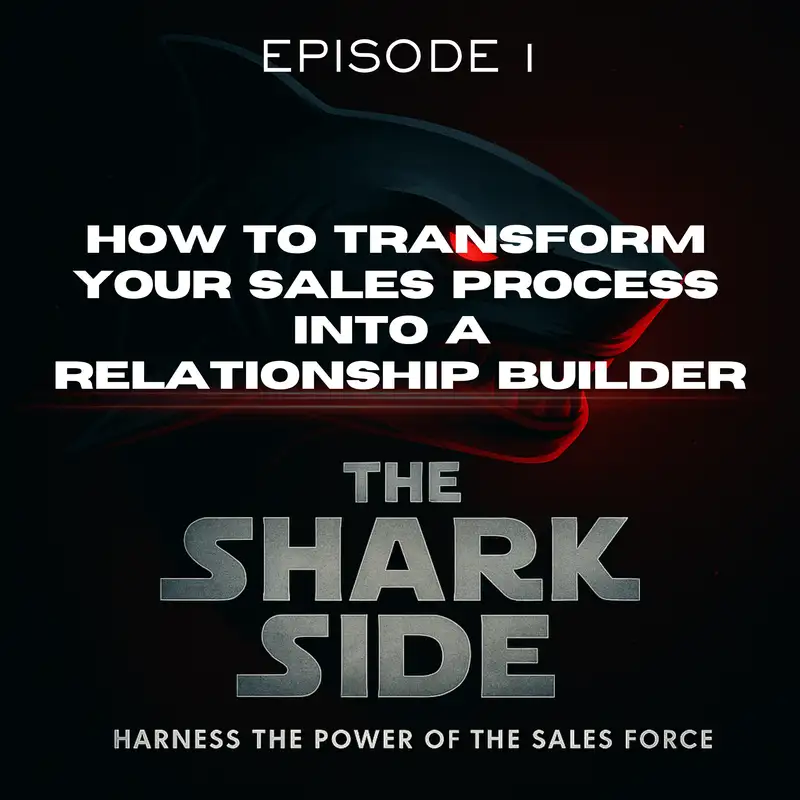
The Shark Side - Episode 1: How to Transform Your Sales Process into a Relationship Builder
Download MP3In every deal, there's power, persuasion, and performance. This is the shark side, where ambition meets discipline.
MJ:Welcome to the shark side. Hey, everyone. This is the shark side podcast. We're gonna talk a little bit about business. We're gonna talk a lot about sales.
MJ:But first, I just wanted to introduce myself. I am MJ Cordova. Many people know me as the shark of sales. I have been in sales for forty plus years. I started when I was really young.
MJ:I have done just about every kind of sales that you can imagine. I've done phone, door to door, business to business, business to consumer. So really had just a ton of experience doing it all. And I have a passion for sales. I have a passion for talking about it.
MJ:I have a passion for sharing my experience with others. I have a passion from learning from other people. And so I really want to get dialed in on having great sales conversations, having great business conversations. I have been a two time business owner. I've been a CEO a couple of times and ran sales organizations, large to small.
MJ:Been doing that type of stuff for twenty plus years, almost twenty five years. And there's so much information out there. Sometimes it gets confusing. Sometimes it's complicated. Sometimes it's just flat untrue.
MJ:So one of the things that I really have as a goal is to be able to talk to people and say, here's what's true, and here's what's not true. I don't have a lot of motive for telling you anything that doesn't work or that's self serving. We are in a generation of mass information, and there's so much out there to consume. We have people, maybe they're like myself, that are just a little, gray in the beard and wanna help others, wanna share some things we learned, some mistakes we made, some success we had. And then there are others out there who are gonna regurgitate nonsense, charge a bunch of money, and not really give value.
MJ:And then there's a bunch of stuff in between. There are people who are very specific to helping out with a certain portion of the sale or a certain industry in sales, and I have some expertise in that stuff. But, really, what I do is cut down to the fundamentals of what is sales. And the reality of that is it's just a relationship. And too many times, you're seeing techniques or conversations out there about how to control, how to manipulate, how to get your desired result in a way that I don't think is necessarily helpful to the other person.
MJ:And if you're the type of person who wants to have that kind of relationship, you probably have that relationship in your personal life too. It's probably not the podcast for you. If you want to talk about what true lasting sales is and getting referrals and building a true business that sustains itself, that has to be built through relationships. So so much of what we talk about here is the relationship part of how do we interact through this sales process? How do we build that relationship?
MJ:What does it mean to each person within that relationship? And when we do that, you see that there's a much more natural way to do business with people. I wrote a book. It's an Amazon bestseller called Map to Sales. And one of the chapters in that book is called Not Everyone Is Your Customer.
MJ:And and I think that too many times we're operating from scarcity, and we really go after and accept situations and relationships in our professional life that aren't healthy, that that aren't the best for us. And the more time we spend on those, the less time we have to spend on the relationships that are good for us, the relationships that we should be nurturing, and the relationships we should be building. So keep that in mind as we go through this journey that we're going to go through. And as you connect with this podcast, and you connect with me on social media or through the website, however that may be. But really understand that fundamentally, this sales relationship, this business relationship is more about the relationship than it is about the ultimate goal, which is to close the sale.
MJ:That will happen naturally and organically when we create healthy, productive relationships that work for both people and both ends. I would like to tell you about a relationship I encountered that was probably the best influence on my sales career. And it really was relatively early on in my career. I was working for Verizon in that time in their advertising division, and I was trying to learn this whole sales process. Previous to that, I had spent several years in sales, and it was more about just being a nice guy, just trying to fulfill customer needs, not really understanding sales process, how to develop that process, how to develop the relationship as I went.
MJ:And so I was with my trainersales manager at a call, and I was going through the steps, which I was trained on, but didn't really understand what they meant. And luckily the client had to take a phone call. So they excused themselves, said, Hey, take this call. Stepped out of the office for a moment. And I still remember Alan telling me, where are you going with this?
MJ:As he had this kind of, surfer voice. He was the coolest guy ever. He says, where are you going with this man? And I was like, I don't know. I'm just following the steps.
MJ:And he walked me through. We're not just going through steps here. What we're doing is we're giving you a roadmap to develop a relationship with somebody. We're giving you a roadmap to understand what they need. And we're all passionate about products and services that we sell, and we like to think what we have is for everyone.
MJ:And in the reality, it's probably not. Most of our companies, if they're well run companies, understand that they have a very specific target client. And our message in our relationship should be centered around that target client. When it is, then as you get to know the client and you understand their needs, you can position yourself to help them through some challenge or towards some goal. And there are so many sales trainers and coaches and gurus out there.
MJ:There's the old school guys who wrote books, ton of books a long time ago, to guys that are up and coming and just taking TikTok by storm. And I know that I gravitate towards some more than others. I know that I gravitate toward solution and relationship style selling more than I do sort of manipulation and positioning style coaches and trainers. So I get asked all the time, what are your favorite sales books? And I think, first and foremost, one that everybody should read is The Greatest Salesman in the World by Og Mandino.
MJ:And that will really give you some perspective on developing relationships and creating value based on need that's a good fit for your client or your prospect. I I tend to lose patience with and even rebel against, defiantly, the more manipulative type sales processes. We we have so many options out there, and and I was in the car business for a time. I was in I sold Harley Davidsons for a while also. That's a brutal industry as far as manipulation goes.
MJ:Some really good techniques as far as understanding clients' emotional drivers, but also some very manipulative techniques in taking advantage of those, emotional drivers. I will tell you where I stand strongly against, and that is the magic wand, of of training, which is just say this, just do that. There's a certain technique, and it it's a it's a funny story, but I was having discussions with someone who was talking about their training program, which is a very well known sales so called guru. And it was door to door. So they're in the home of the person who's looking to buy a service.
MJ:And part of the training was the person saying, well, I need to talk to my husband about this. And the response was, well, let's get him on the phone. And to me, that is like, I don't know about you guys. Me personally, I would toss that person out of my house so quickly. If I said, hey, I'd like to run this by my wife.
MJ:And somebody said, let's get her on the phone. That is not a relationship. That is not putting the needs of your client first. That is manipulative, and it's fear based selling. What I would tell you is, I work with several companies in the blue collar space, couple roofing companies, And there's a big debate in that industry about one call closing.
MJ:How hard do you push to close on the spot? I understand why they do it. Mostly because once you leave the home, once the client leaves the lot, once they leave your office, once you're off the Zoom call, the chances of closing that sale go down significantly. And I understand that. That is just a ratio that is within your metrics.
MJ:I would politely, if the relationship dictates that you've earned the right to ask for the business every single time. If there is a concern or a need to wait or talk to someone else, there's some minor adjustments we can make. Maybe we qualify the appointment by saying, hey. Are all the people who need to talk about this gonna be there? There's some questions I can ask with regard to trying to move that farther along in the sale or close even.
MJ:But the reality of it is if somebody's not ready to make that decision, not capable of making that decision comfortably, and we force them into it, our cancel rates are going to go up, our customer satisfaction with the project is going to go down, our ability to ask for referrals is going to go down, our reviews are going to go down. And it's really a scarcity mindset. I have not done a good enough job in finding out what you actually need, providing a solution that makes sense, that you're comfortable with, for me to walk away and feel confident that you and I are gonna continue with this relationship. And I don't operate from fear. I truly believe that if I'm in a situation where you and I are talking about your needs, and I've qualified you, and you are my ideal client, and I have a solution that fits your needs, that solves a problem for you, that gets you closer to a goal, I am not fearful about letting you think about that overnight.
MJ:I'm just not. I don't think anybody else has done that good a job. I've been around sales long enough to know. I know what I'm up against. I know these other people are going to be pushing hard.
MJ:I know they're going to tell you to get your spouse on the phone, which to me is extremely insulting. I know my significant other, if you told her, let's call him right now, she would flip out. She'd and and I would too. I trust her to make any decision she needs to make. And if she doesn't wanna make it right now, that's her choice as as it would be mine.
MJ:And so it's really condescending and insulting to people to say, why don't we get them on the phone? And to me, for all these flat bill hat, tight T shirt guys walking around, mister tough guy, why don't we get him on the phone? That is the epitome of weakness. You are showing fear when you do that. You know what?
MJ:I go into this fearlessly. I've prequalified. I know who my ideal client is. I know what my value to them is. I found out exactly what it is they need.
MJ:And I've provided a solution that makes sense. I am not afraid to let them think about it. I will ask them what questions or concerns do you have before I leave. What additional information would help you make this decision? When they give me that information, I'll get it to them.
MJ:But I think people need to get back to creating relationships and having respect for the process and the client. Sales and marketing are two different sides of the same coin. They're both related to customer acquisition. And I think too many times people put too much weight on marketing to try and make up for sales deficiencies. There is a trend in many cases to be the loudest, to be the most vocal, to be the most frequent, to be the most branded.
MJ:And I don't think that there's anything wrong with that, as long as it's part of a larger business plan. We have to understand, number one, I've said it over and over again. And one of the largest problems that businesses face, and by default, salespeople for those businesses have, is that there's not a properly defined ideal customer. When we properly define our ideal customer, the market is going to tell us where they are, how they consume information, how they like to be marketed to, what they respond to. Then that marketing allows us to be very top of mind.
MJ:People are aware of our brand. They're aware of who we are. It gives us credibility in most cases, unless people hate you, which is common at times too. But marketing is there to generate interest and to support sales. At times, depending on the company, the industry, etcetera, marketing generates leads, which the salespeople will then follow-up on.
MJ:But it it's it's kind of a fine line that people confuse the two and think that there's actually more overlap than there is. And what we have to understand is that the brand itself has to be attractive to our ideal client in the time and media and area that are attractive or our client is in. And then our sales process and message has to match the brand, the marketing, the message, and what our ideal client is looking for. So it's kind of complicated sometimes because we want marketing to do all of our work for us because we're lazy inherently. And that's fine too.
MJ:Better, bigger, faster is always good in most cases. But sometimes we don't think of how the dominoes fall. We we buy a billboard, and we expect that to generate leads. Or we think if we post on Facebook three times a day, it's gonna generate leads, and then we don't have to do sales activities. And the reality is marketing has to be very specific, and most people don't do marketing well.
MJ:They just do a lot of bad marketing. By default, it generates awareness, generates a lot of leads. And because they're spending so much time and attention and money on marketing, they don't spend as much time on what that sales process is. Think of your life. Think of the relationships you have in your life.
MJ:And if before you went into all those relationships, whether it's a romantic relationship, a work relationship, a relationship with your children, somebody gave you a successful road map to here's how to have a healthy, productive relationship that both people benefit from, think how much better off all of our lives would be. And sometimes in our personal life, it's a little bit more difficult to do. But in our professional life, it is absolutely possible that we can set out and have a very intentional scripted conversation that will develop trust that it's required to learn about our potential clients' needs and then position our product or service to successfully meet those needs and help them reach their goals or prevent whatever catastrophe you were preventing. And so sometimes people think that that sales is this art that you roll in there, you have a couple of jokes, you have great smile, you buy a drink, slap them on the back, tell a couple of jokes, ask a couple of silly questions, and all of a sudden, now you're in position to do the closing questions. And and it's much more complex than that because people are more complex than that.
MJ:Emotions are more complex than that. Situations are more complex than that. And if we go back to all of these sales gurus and coaches and their silly nonsensical stages and productions and podcasts, and they're manufactured with a bunch of rah rah, and they're manufactured with bringing their wife on stage. And what I have to tell you is if you enter into a relationship with a coach or a trainer or a consultant, which I encourage you to do because most cases, you can find somebody that's an expert in an area that you are not. And by leveraging a relationship with them, you're going to be better off.
MJ:Your business can be better off if you're going to enter into a relationship with one of those people. What I would tell you is if they make more money off your relationship than you do, you're in a shitty relationship. Find somebody and ask the questions, and we'll do another podcast where I'll I'll I'll help you interview a consultant or a coach or a trainer. Again, I will tell you this. I do not operate out of fear.
MJ:What I tell you, I do. What I ask you to do, I cold call. I reach out on social media. I do all the things that I help my clients do. What I don't do is put on a big production, create this little fake stage in a warehouse so that I can look like something I'm not.
MJ:I could today probably get a very senior job in a big corporation, making a lot more money than I make right now. Probably wouldn't be happy doing it. I could easily build a fake stage and put a bunch of stuff on social media about how I'm this expert. How does that help you? How does that help my clients?
MJ:One of the reasons I don't do seminars is because every situation is so individual. Every company is so individual that can I put on a seminar and you'll take away a couple of tips and tricks that will help you? Absolutely. The value per dollar that you would get doing that versus having me come in and understand your business, understand your strengths, understand your weaknesses, understand your market, where you're positioned in that market, who your ideal client is, who your competition is, can't be done from a stage. It can only be done one to one.
MJ:And that's why all of these guys are doing stages, and they're all doing Zooms, they're all doing programs will help. But that's like telling an overweight person, well, just eat carrots for lunch. It'll help. But is that really going to solve the big problem? What about exercise?
MJ:What about the rest of their day? Is it really going to help to eat carrots for lunch? If they're eating a chocolate cake for dinner? And that's my challenge with some of this guru stuff is it's so manufactured and it's so self serving because they need the ego play to be on stage. They don't have enough personal experience or intellect for that matter to dive into a business and really teach somebody what the numbers look like, what the numbers are about.
MJ:So all they do is regurgitate nonsense they heard at a seminar from a guy who heard something at a seminar from a guy who went to one of the big gurus and spent way too much money. Related to that, another piece of information is generally when you look at the sales profession, in most cases, it is predominantly male. There's obviously going to be some exceptions. Pharmaceutical sales has more females. Real estate tends to have more females than males.
MJ:In that though, the vast majority of the training is done by males. The vast majority of the training is male centric. And especially when you get into this crazy dynamic of the home services businesses, because I do work a lot blue collar in the air conditioning and plumbing and roofing and and painting. The crazy dynamic is you get the flat build, hat, tight shirt, chest thumpers selling to females, because we know through research that 63% of home buying decisions are made by the female. And so it's it's a challenge for women out there to get great information in a manner that works for them because most of these sales gurus and trainers are male.
MJ:Most of them follow a very aggressive sort of, again, for lack of a better word, the type t shirt wearing flat belt hat guy who just wants to pound you into submission until you buy. And women don't buy that way. Most, most women buy by creating a relationship and understanding that that person who is selling to them is trying to create a relationship where both people win. I'm selling you a product or service that you and your family need or want, and we're both going to win because of this. And so I think that there's a lot of space for women to find someone who understands more about taking time, understanding the needs of the family, and then the needs of the person, understanding that they are the right customer for them, and we're the right supplier for the customer, and everyone's needs are being met.
MJ:I would love to see I know there are female sales trainers out there. I've seen them on TikTok, and I've seen them on YouTube. I I would love for one of them to become as famous and predominant as a lot of these other guys are. They're hyper masculine. I had a great time talking to you guys by myself today.
MJ:Occasionally, I'll have guests. But mostly, it's just gonna be about, a bunch of sales and business stuff. Maybe we'll talk sports every once in a while, some relationship stuff. It's all interconnected anyway, but enjoyed doing this with you. Hope you come back, and we'll talk to you guys again soon.
Narrator:Thanks for watching. Visit our website and follow us on social for more. Until next time. Stay sharp.